


Empowering Tarana Deployments: Reliable DC Power for Tekwerks
PRODUCT BUNDLE
Overview
Tekwerks Internet is a local provider of internet, IT, and phone services based in the San Fernando Valley area of Los Angeles (California).
Just like all the good tech companies, it was founded in a garage in 1986 and today has grown into a company with two subsidiaries across Southern California.
Its mission has always been to deliver unique and innovative solutions utilizing the best of available technologies and services to help their businesses customers grow.
Their research of the best technologies for their projects has brought them to us.
Challenge
Tekwerks had just started using Tarana, an advanced radio system for Fixed Wireless internet service designed to provide high-density point-to-multi-point broadband internet (ngFWA).
To function properly, Tarana Base Node Access Point radios operate as high-capacity fixed wireless access nodes requiring substantial and highly stable electrical input.
A single tower radio system can draw between 800 W and 1.5 kW under peak traffic load.
Given 24/7 operation and carrier-grade availability requirements (>99.99% uptime), even minor voltage fluctuations or ripple can directly impact RF performance, modulation stability, and overall network throughput.
Consequently:
- robust rectification
- battery backup autonomy (4–8 hours typical)
- surge-protected distribution architectures
are mission-critical for reliable tower performance.
Solution
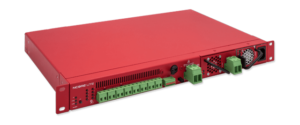
To meet Tekwerks’ requirement for a compact, high-reliability DC architecture, we deployed the nCore-Lite as the centralized 48 VDC power platform for their Tarana tower implementations.
Configured with dual AC input modules, the system maintains a stable 51–52 VDC bus under load, and four 12 V / 100 Ah batteries arranged in a 48 V, 100 Ah string as backup.
All tower equipment is powered directly from the main DC distribution — including the Tarana Wireless radio drawing 3.5–4.1 A at 51 V, a MikroTik router and PoE switch, multiple sectorial Ubiquiti antennas, and a Siklu 80 GHz backhaul link and its backup.
Total site consumption averages 5–6 A on the DC bus, with integrated monitoring providing real-time voltage and load telemetry.
In the event of grid failure, the battery subsystem delivers 8–10 hours of autonomy, ensuring continuity of service
With over 395 days of continuous operation in the field, nCore-Lite has demonstrated carrier-grade resilience, clean power delivery, and seamless generator integration for remote FWA deployments.
Results
By integrating nCore-Lite into their tower infrastructure, Tekwerks Internet achieved greater reliability, extended backup autonomy, and simplified power management across their Tarana deployments.
The result is uninterrupted connectivity for their customers, even during grid outages, with a power platform built to scale as demand grows.
This project shows how the right energy backbone will transform network performance into a long-term competitive advantage.
Want to share your 9dot success story?
Get in touch with us, your story will be featured on our website or social media!
Contact us